





- Little Regent Nursery
- Behaviour
Teaching Children Basic Manners
Manners are not a set of rules to be memorised. They are the small everyday habits that show a child has noticed someone else exists - and that awareness is a developmental achievement, not an instruction you can issue.
Which is why prompting a two-year-old to say thank you fifteen times a day rarely produces a polite three-year-old, and modelling it does.
Children copy what you do far more reliably than they follow what you say. Say please to your child and you will hear it back.
Start with two words
Please and thank you are enough for the first couple of years. Use them yourself constantly - to your child, to your partner, to the person at the till. Say them warmly rather than pointedly. Children absorb tone before vocabulary.
Prompt gently, then stop
A quiet "what do we say?" is fine. Repeating it, insisting, or withholding the biscuit until the word arrives turns a social habit into a power struggle, and children will always win a power struggle by refusing. Give the prompt once and let it go.
Understand what sharing really is
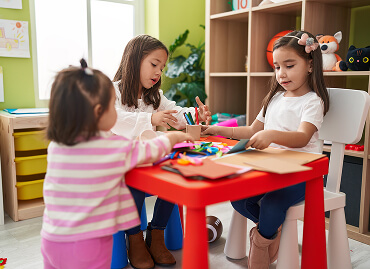
Under about three, children genuinely cannot share in the way adults mean it. Taking turns is the achievable version. Use a timer, name the feeling - "you really want that, and it is Amira's turn first" - and stay nearby. Forcing a toy out of a toddler's hands teaches only that bigger people take things.
Practise greetings without pressure
Some children say good morning happily from the start; others need months. Never announce that your child is shy - they will hear it and believe it. A wave, a nod or standing beside you counts. Confidence grows when the pressure comes off.
Teach table manners in small pieces
Sitting down to eat, keeping food on the plate, waiting until everyone has been served, saying may I leave the table. Choose one at a time and expect it to take weeks. Eating together as a family, even briefly, does more than any amount of correction.
Notice it when it happens
Catch the moment your child holds a door, hands over a toy or greets someone unprompted, and name it specifically: "you waited while she finished - that was kind." Specific noticing is far more powerful than general praise, and far more powerful still than criticism.
Be patient with the regressions
Tired, hungry, unwell or overwhelmed children forget everything they know. This is not defiance; it is capacity. Manners return when the child does.
Personal, social and emotional development is one of the three prime areas of the EYFS, and at Little Regent Nursery it runs through circle time, snack time and every shared activity of the day. To see how our educators support it, come and visit us in Al Ain.

Post A Comment